BPC-157 nerve regeneration after a cut sciatic nerve
The strongest nerve experiment checked structure, electrical signaling and walking. All of those results came from rats.
Can BPC-157 help nerve damage?
Human benefit for nerve damage remains unestablished. The sciatic-nerve experiment concerns a deliberately cut nerve in rats. The spinal-cord injury work also concerns rats, while the small human reports summarized in the 2025 review studied other questions.
I regard nerve regeneration as one of the most interesting BPC-157 claims precisely because the animal study went beyond an impression of recovery. Whether a damaged human nerve would respond remains an unanswered clinical question.
Structure, electrical signals and walking
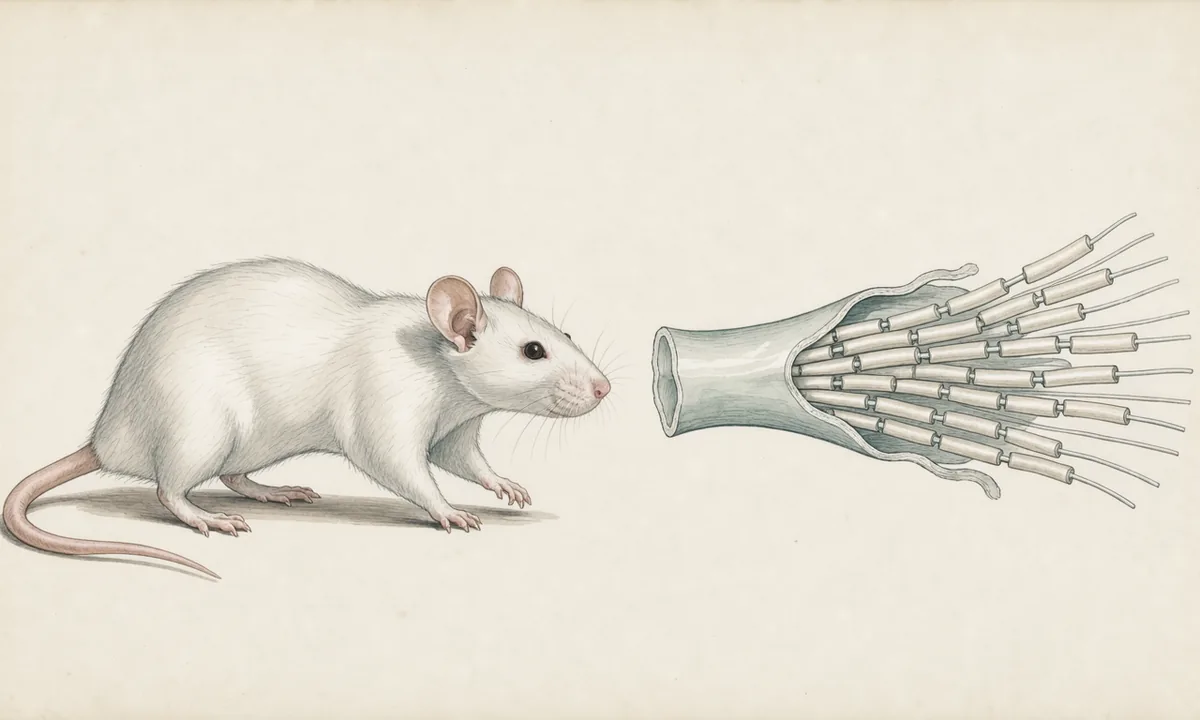
Gjurasin and colleagues' 2010 traumatic nerve-injury study examined the sciatic nerve after transection in Wistar rats. The treated animals showed axonal regrowth, improved myelination, restored motor action potentials and better sciatic function. Myelin is the insulating coat around a nerve fiber; an action potential is its electrical signal.
These measurements ask related but distinct things. Microscopy checks the fibers and their coats. Electrical testing asks whether a signal travels. The movement assessment asks whether the leg works better. To my mind, checking all of those makes a stronger animal result than microscopy alone.
The researchers studied administration through the abdomen, stomach or locally with nerve tubing. These were experimental rat procedures. No comparable human nerve-repair trial is established in the cited record.
Spinal-cord injury in rats
The 2022 spinal-cord injury paper reported recovery of early and definitive features of spinal injury in rats. It belongs to a separate experimental setting from a cut peripheral nerve. A sciatic nerve and a spinal cord carry different injuries and different recovery problems.
The breadth of the recovery claim leaves me hesitant, even while the ambition interests me. Repetition by other laboratories, with the same functional outcomes, would make the report easier to place. The available human pilots supply no spinal-cord outcome.
Serotonin and rat behavior
The brain findings are another set of experiments. A 2004 autoradiography study measured region-specific changes in serotonin synthesis in rat brains. Some areas increased production and others decreased it. That is more complicated than describing BPC-157 as a general serotonin booster.
In forced-swim and chronic-stress models, rats showed antidepressant-like behavior. A separate serotonin-syndrome experiment found reduced syndrome severity in rats. The behavioral findings and the chemical measurements came from different studies; their relationship remains a proposed explanation.
None of those observations establishes how a person feels after BPC-157 or supports a human antidepressant claim. Changes involving serotonin also raise a theoretical interaction concern for medicines that affect that system. Human interaction studies are absent.
Blood supply around an injury
The VEGFR2 angiogenesis study found increased vessel growth in animal and cell models and faster blood-flow recovery in ischemic rat muscle. Better blood supply is a plausible contributor to repair. It has not been established as the cause of the nerve results.
The sciatic-nerve findings are compelling enough to deserve an explanation that survives a direct test. Attributing every result to improved circulation would skip that work.
Questions for the next nerve experiment
The overlap between the electrical and movement results interests me most: do both recur when an unrelated laboratory repeats the experiment? How durable is the recovery, and what adverse outcomes appear with longer observation? Those are research questions.
For people asking about numbness or weakness, the published human evidence still supplies no nerve-regeneration result. The human-study record and safety reports describe the much smaller amount that has actually been observed in people.