Safe BPC-157
BPC-157 safety and the human headcount
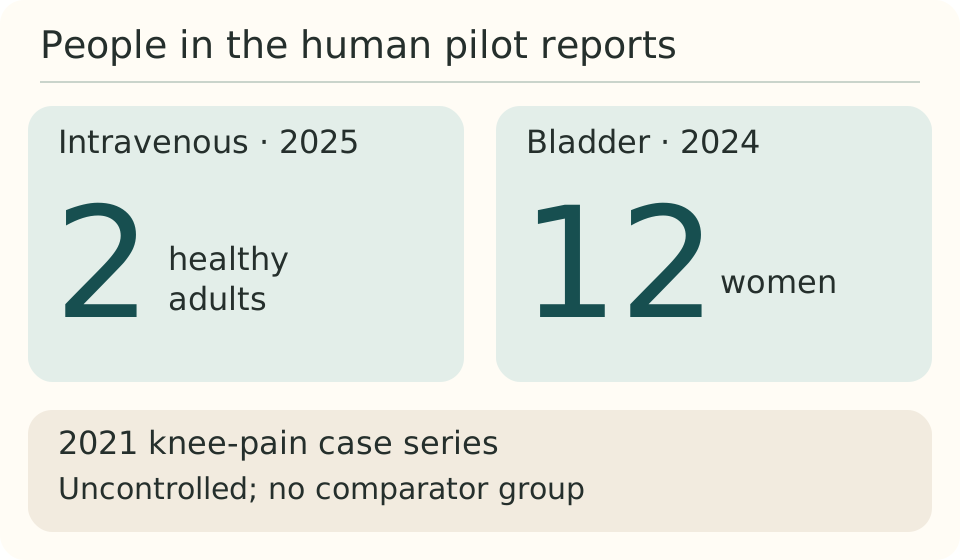
Two adults in the intravenous safety pilot. Twelve women in the bladder pilot. Those are useful beginnings, and very small foundations for reassurance.

Pilot populations
The 2025 intravenous safety pilot followed two healthy adults and recorded no adverse events or measurable changes in the safety biomarkers it checked. That result deserves to be reported accurately. I balk at extending that result to a broad assurance of safety.
A bladder-symptom pilot in twelve women and an uncontrolled knee-pain case series make up the other human reports described in the 2025 narrative review. The procedures and questions differed. Adding the reports together would still leave the duration of observation, the comparison groups and the possibility of uncommon harms to answer.
The counts below belong to separate studies. They give the human record some scale; they cannot produce a pooled safety rate.
A peptide with a gastric origin
BPC-157 stands for Body Protection Compound 157. It is a synthetic chain of fifteen amino acids based on part of a protein found in human gastric juice; the fragment itself is not a naturally circulating peptide. Its gastric lineage and reported stability in stomach juice sit behind the early rat ulcer experiments.
Even the expanded name sounds reassuring. The comforting sound troubles me: protection is already in the name before a human safety question has been asked. The molecule's origin explains a research interest. Long-term effects in people require their own observations.
Tendons and stomach ulcers in rats
The completely severed rat Achilles tendon study is more substantial than a vague report of faster healing: treated rats had better tendon strength and function, with improved collagen organization under the microscope. A separate gastric-ulcer study in rats found less ulcer formation and faster repair of the stomach lining.
These BPC-157 benefits were measured in injured animals. I take the mechanical strength result seriously because it asks whether the repaired tissue can do a job. The prospect of human benefit remains open, with far less evidence behind it.
Vascular growth signals
Angiogenesis, the growth of new blood vessels, offers a possible connection between otherwise very different injury experiments. In chick, rat and cultured human blood-vessel-cell models, BPC-157 increased vessel growth and improved blood-flow recovery in ischemic rat muscle. The receptor involved was VEGFR2.
That same activity raises an unanswered cancer-safety question, because tumors also depend on a blood supply. The concern comes from the mechanism; the cited work has not established a human cancer effect. The research record still needs large, controlled human trials and long follow-up.
Nerve damage and regeneration
A cut sciatic nerve in rats regrew with improved nerve-fiber structure, electrical signaling and movement after BPC-157. Those different measurements make the experiment worth a close look. The spinal-cord injury findings also come from rats.
The dedicated BPC-157 nerve regeneration page follows the actual measurements and the separate rat brain experiments. Human nerve repair has yet to be established.
FDA status and practical questions
BPC-157 lacks FDA approval. On FDA's page current as of April 22, 2026, the free-base and acetate nominations appear in the withdrawn-nominations table, outside Category 2. The withdrawal leaves the published safety concerns in place and grants no new authorization for pharmacy compounding.
The legal-status page covers the prescribing and pharmacy requirements. Side-effect reports, study amounts and the drug-test and liver-damage FAQ address the questions that tend to get lost behind a broad safety claim.